Let's start with the basics:
1) Vaccines do not cause autism. They also do not cause asthma, leukaemia, hay fever, type 1 diabetes, gait disturbance, Crohn's disease, demyelinating diseases, bacterial or viral infections, or bad hair. At last count, the evidence supporting this claim included 5 randomized control studies, one controlled trial, 27 cohort studies, 17 case-control studies, 5 time-series trials, one crossover trial, 2 ecological studies, and 6 self-controlled case-series studies. Combined, these studies include data from just shy of 14.8 million children, from at least four different countries, and span a period of almost two decades, a time span that meets any reasonable definition of "long term," and quite a few unreasonable ones. These studies have consistently shown that the risk of serious side effects from the vaccine is vastly smaller than the risk of serious effects from the disease they prevent.
2) There is no profit motive for Big Bad Pharma, or really, anyone else, to convince anyone that vaccines are safe. Quite the contrary, the strongest profit motive is, consistently, to convince people that they are as dangerous as possible. Here are just a few examples:
2a) Mr. Andrew Wakefield had patented a measles vaccine a few months before he proposed that they should switch to the exact vaccine he had patented. His patent would be worthless unless confidence in the extant MMR vaccine could be shaken. All that was a coincidence I'm sure. Since then, he's made a killing selling books to people stupid enough to believe his persecution complex, books that would be worthless if his customers believed that vaccines were both safe and effective. Therefore, Mr. Wakefield has had at least two clear profit motives to convince people that vaccines are dangerous.
2b) Mr. David Mercola has made himself an obscenely rich man partly by peddling a "natural alternative" to vaccination that has never actually been shown to work (on the contrary, its effects are consistently indistinguishable from a similarly-administered placebo). Obviously, his products are worthless if vaccines are seen as safe and effective, giving him a clear profit motive to convince as many people as possible that vaccines are dangerous.
2c) Mr. Mark and David Geier have made themselves quite rich by convincing desperate parents that vaccines cause autism, then chemically castrating austistic children in an (invariably, failed) attempt to cure it. No, by the way, that isn't an exaggeration at all; until they lost their licenses to practice medicine, they literally did exactly that. They called it the Lupron protocol. Not only are Mr. Mark and David Geier reprehensible excuses for human beings, the treatment they propose has absolutely no chance of working unless vaccines cause autism, so they clearly have a strong profit motive to convince as much of the public as possible that vaccines actually cause autism. Or at least, they did, until the medical ethics boards of every state where they had been licensed to practice medicine decided that castrating children was crossing a bit of an ethical line.
2d) Pediatricians? They have a very clear profit motive not to vaccinate. A recent study analyzed how much money pediatricians actually make off of vaccines (Margaret S. Coleman, PhD, Megan C. Lindley, MPH, John Ekong, MPH, Lance Rodewald, MD Net Financial Gain or Loss From Vaccination in Pediatric Medical Practices PEDIATRICS Vol. 124 pp. S472 -S491). The conclusion of this study? At best, pediatricians break even, or, in specific cases, turn a minuscule profit. On average, they generally lose money every time they administer a vaccine.
2e) As for Big Bad Pharma? The profits they make off of vaccines, per year, essentially amounts to round-off error. They're expensive to produce, difficult to get approved, and high-risk. They also kill profits in other areas of business. Every single dollar spent on, just to name one, the MMR vaccine, saves about $30 more (Zhou, et al., J Infect Dis, 189(2004): S131-145). On average, for every dollar spent administering the vaccines on the standard schedule, around $10 more are saved. Whether vaccines are administered or not, a fair amount of money goes into a pharmaceutical company's pocket, but if we stopped vaccinating, there would be a lot more of it. There is very little to gain on Big Pharma's part for manufacturing vaccines.
Faced with this, a lot of anti-vaccination advocates (the honest ones -- the ones who realize that they can't deny, for instance, that Big Pharma would make a lot more money if they halted all vaccinations, or that a lot of prominent anti-vaccination advocates either have, or have tried to make obscene amounts of money off of that position) go way off the deep end of the stupid pool. Sure, they'll say, vaccines are a profit killer, and the last thing that Big Pharma would ever want to do is convince you that vaccines are safe, but what they're really doing is causing everyone to get autism (setting aside, for the moment, that vaccines don't actually cause autism), so that they can make money off of treating that. In other words, Big Pharma cannot possibly have a non-evil motivation for providing vaccines to the marketplace.
To understand just how unbelievably, mind-bogglingly stupid this is, we again need to cover a few basics:
1) Big Pharma doesn't make any money off of off-patent drugs. It's called a "patent cliff" for a reason. Here's what happened to the profits Johnson & Johnson made off of Plavix when its patent expired.
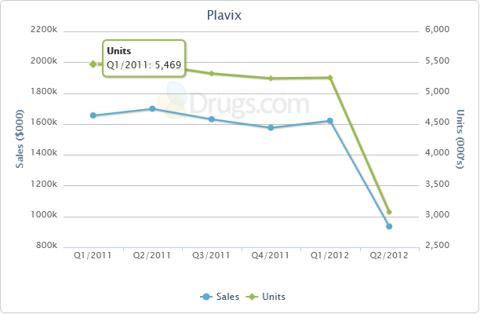
This is the norm, by the way, not the exception. Once a pharmaceutical company loses its patent, it no longer makes any money off of the drug it once had patented. Then it's the generics manufacturer's turn to make money. While a lot of pharmaceutical companies have wholly-owned generics companies under their respective umbrellas, the amount made of the drug in generic form is not remotely sufficient to recoup their daily cost of operation.
2) There are no drugs that cure autism, or even treat its primary symptoms. The only people who claim otherwise have never shown their treatments to actually work; and often require procedures that are ineffective, and in some cases even dangerous (see above, re: Mark and David Geier).
3) There are, however, some drugs that can treat some of the related symptoms.
4) However, none of those drugs are patented. The primary treatments for symptoms associated with autism are Prozac and Zoloft (whose patents expired in 2001 and 2006 respectively). In addition, some antipsychotic medications are sometimes used to control energy levels (Resperidol is the most common; its patent expired at the end of 2003, closely followed by Haloperidol, which has been out of patent since the '80s). Ritalin has been shown to have beneficial effects on people with ASD (its patent expired in 1967).
To be clear, a lot of pharmaceutical companies are researching ASD, and attempting to develop pharmacological interventions that may alleviate its major symptoms. The amount spent on this research runs in the range of 2-5 billion dollars per year, depending on the company you're talking about.
So, in summary, there are a few rather major flaws with the narrative they are proposing.
1) For this narrative to be true, Big Pharma would have to have drugs marketed that make money off of treating autism. They don't.
1a) Therefore, if this narrative were true, they would be causing a disease that they have absolutely no way of making money off of, and will not for the foreseeable future.
2) If this narrative were true, it would mean that Big Pharma already knows what causes autism, and therefore wouldn't need to spend billions researching its causes and progression.
2a) So, for this narrative to be true, Big Pharma would have to be knowingly wasting billions of dollars researching the underlying causes of a disease that they themselves are knowingly causing.
4) Finally, and most importantly, for this narrative to be true, vaccines would have to actually cause autism.
4a) So, for this narrative to be true, they would have to spend enormous amounts of money manufacturing all of the evidence evidence that vaccines do not cause autism (since that's literally what all of the evidence says), and concealing evidence that it does (since nobody has yet produced any), to keep a product on the market that they don't make much money off of, in order to increase the prevalence of a disease that they can't make money off of, and won't be able to for the foreseeable future.
The TL;DR version? They're literally arguing that Big Phrama is an evil, profit-mongering corporation, that is pursuing a strategy that cannot possibly produce a profit any time in the foreseeable future.
Thank you for your attention.
Showing posts with label child abuse. Show all posts
Monday, September 22, 2014
Tuesday, December 07, 2010
Another reason why Anti-vaccination advocates are idiots, part II
I've got some criticism as to how I didn't actually support my premise that there's a lot more money to be made off of not vaccinating than vaccinating.
Now, first, let's start with the basics: the numbers in the right hand column are not costs of a dose of any of those vaccines. They're very conservative estimates of the amount of money every dollar spent on those vaccines saves. In other words, if you spend one dollar on a TDaP vaccine, you save 27, and so on.
Now, the sources for this data are as follows:
For the TDaP vaccine,
Ekwuemeet al, Arch PediatrAdolescMed, 154(Aug 2000): 797-803
MMR:
Zhou, et al., J Infect Dis, 189(2004): S131-145
Hib:
Zhou, et al., Pediatrics, 110:4(Oct 2002): 653-661
Varicella:
Lieu, et al., JAMA, 271(1994): 375-81
None of these scientists have any connection to any pharmaceutical company.
If you look at just these four vaccines, for every dollar spent on a vaccine, just shy of 16 dollars are saved. That money would go into the pockets of the very pharmaceutical companies that anti-vaccinations advocates so insist are lining their pockets by forcing vaccines upon the unwilling public. They'd make a lot more by letting everyone just get the measles.
What is the most profitable vaccine on the market? The one that isn't given.
| TDaP | $27.00 |
| MMR | $26.00 |
| Hib | $5.40 |
| Varicella | $5.45 |
Now, first, let's start with the basics: the numbers in the right hand column are not costs of a dose of any of those vaccines. They're very conservative estimates of the amount of money every dollar spent on those vaccines saves. In other words, if you spend one dollar on a TDaP vaccine, you save 27, and so on.
Now, the sources for this data are as follows:
For the TDaP vaccine,
Ekwuemeet al, Arch PediatrAdolescMed, 154(Aug 2000): 797-803
MMR:
Zhou, et al., J Infect Dis, 189(2004): S131-145
Hib:
Zhou, et al., Pediatrics, 110:4(Oct 2002): 653-661
Varicella:
Lieu, et al., JAMA, 271(1994): 375-81
None of these scientists have any connection to any pharmaceutical company.
If you look at just these four vaccines, for every dollar spent on a vaccine, just shy of 16 dollars are saved. That money would go into the pockets of the very pharmaceutical companies that anti-vaccinations advocates so insist are lining their pockets by forcing vaccines upon the unwilling public. They'd make a lot more by letting everyone just get the measles.
What is the most profitable vaccine on the market? The one that isn't given.
Monday, September 13, 2010
Another reason why Anti-vaccination advocates are idiots
I shouldn't have to say this, but I do.
I receive no funding whatsoever from any pharmaceutical or biotechnology company in existence anywhere in the world.
None.
Zip.
I have never so much as seen a single penny from one in dividends, project support, or salary from any pharmaceutical company. Indeed, all funds I have ever worked for come from competitive grants from the NIH or the AHA. Currently, the entirety of my salary is paid by a postdoctoral fellowship from the American Heart Association. The AHA, in turn, is entirely funded by private donations which the individual donors can apply to their tax returns. I have no knowledge of who the individual donors are, and therefore can have no possible knowledge of their individual motivations or what they wish for my research to show, therefore, it is completely and utterly impossible for any pharmaceutical company to exert any influence upon me, even if I were performing any research which would motivate them to do so. I am not. The AHA has no say on whether, or what, I publish, and holds no power over my academic freedom.
Further, I receive no funding, support, or salary from any manufacturer of vaccines. See above.
Pretty much anybody who speaks out against the idiocy that is the anti-vaccination movement has to include a disclaimer like the above.
Now, here's why they shouldn't have to.
It takes a truly delusional mind to claim, with a straight face, that the reason pharmaceutical companies produce vaccines is to turn a profit. Yes, there are a few vaccines that have made quite a lot of money for the manufacturers. Gardasil, for example, made its manufacturers somewhere in the ballpark of 1.5 billion dollars.
Setting aside the fact that making money off of an exceptionally effective treatment which reduces a woman's chance of developing cervical cancer to nearly zero is not implicitly evil (as much as anti-vaccination advocates would like you to think otherwise), Gardasil is deep, deep in the minority.
In general, vaccine production is so ridiculously unprofitable, convincing manufacturers to make the vaccines is a challenge in itself. The single most-applied vaccine worldwide the BCG vaccine against tuberculosis. Its profit margin is, for all practical purposes, zero, once transportation to the needed areas is taken into consideration.
But for the moment, let us assume that that is not the case. Let's assume that all doses are created equal, profit-wise. A dose of viagra makes the exact same profit as a dose of the Tdap vaccine.
Which of the two will turn a greater profit: one dose of the vaccine, or a month's worth of drugs to keep the symptoms under control?
In short, if vaccine manufacturers were really the profit-grubbing evil entities that the anti-vaccine morons believed they were, they wouldn't make vaccines. They'd want as many of us to catch the disease as possible for one simple reason: it's vastly more profitable to treat a disease than it is to prevent it.
I receive no funding whatsoever from any pharmaceutical or biotechnology company in existence anywhere in the world.
None.
Zip.
I have never so much as seen a single penny from one in dividends, project support, or salary from any pharmaceutical company. Indeed, all funds I have ever worked for come from competitive grants from the NIH or the AHA. Currently, the entirety of my salary is paid by a postdoctoral fellowship from the American Heart Association. The AHA, in turn, is entirely funded by private donations which the individual donors can apply to their tax returns. I have no knowledge of who the individual donors are, and therefore can have no possible knowledge of their individual motivations or what they wish for my research to show, therefore, it is completely and utterly impossible for any pharmaceutical company to exert any influence upon me, even if I were performing any research which would motivate them to do so. I am not. The AHA has no say on whether, or what, I publish, and holds no power over my academic freedom.
Further, I receive no funding, support, or salary from any manufacturer of vaccines. See above.
Pretty much anybody who speaks out against the idiocy that is the anti-vaccination movement has to include a disclaimer like the above.
Now, here's why they shouldn't have to.
It takes a truly delusional mind to claim, with a straight face, that the reason pharmaceutical companies produce vaccines is to turn a profit. Yes, there are a few vaccines that have made quite a lot of money for the manufacturers. Gardasil, for example, made its manufacturers somewhere in the ballpark of 1.5 billion dollars.
Setting aside the fact that making money off of an exceptionally effective treatment which reduces a woman's chance of developing cervical cancer to nearly zero is not implicitly evil (as much as anti-vaccination advocates would like you to think otherwise), Gardasil is deep, deep in the minority.
In general, vaccine production is so ridiculously unprofitable, convincing manufacturers to make the vaccines is a challenge in itself. The single most-applied vaccine worldwide the BCG vaccine against tuberculosis. Its profit margin is, for all practical purposes, zero, once transportation to the needed areas is taken into consideration.
But for the moment, let us assume that that is not the case. Let's assume that all doses are created equal, profit-wise. A dose of viagra makes the exact same profit as a dose of the Tdap vaccine.
Which of the two will turn a greater profit: one dose of the vaccine, or a month's worth of drugs to keep the symptoms under control?
In short, if vaccine manufacturers were really the profit-grubbing evil entities that the anti-vaccine morons believed they were, they wouldn't make vaccines. They'd want as many of us to catch the disease as possible for one simple reason: it's vastly more profitable to treat a disease than it is to prevent it.
Labels:
child abuse,
idiots,
medicine,
personal,
public health,
rant,
science,
vaccination
Monday, October 26, 2009
If there is a Hell, Jenny McCarthy and Jim Carrey will spend eternity in an Iron Lung
Okay, let me start with a full disclosure of my own biases:
The anti-vaccination movement is potentially the single greatest threat to public health.
Note that I don't qualify that as "in America," or "in the third world" or "in westernized countries." They are potentially the single greatest threat to public health, period.
Let me go a step further, if you do not get your child vaccinated, or worse, you convince someone else not to get their child vaccinated, you are guilty of child abuse by any reasonable (if not legally-actionable) definition of the term. You're playing roulette with their lives and hoping that they're fortunate enough never to be exposed to any of the diseases which vaccines will protect them from.
Also in the interest of full disclosure, I should mention the following: vaccines are, collectively, the lowest-cost, highest effectiveness, most portable, dispersable, and long-term solution to most of the world's diseases. This, incidentally, is not a matter of my own opinion, it's a matter of track record. Small pox, polio, tetanus, diphtheria, measles, rubella, and other diseases which, in Canada and the US, are little more than a distant memory. It's estimated that one in five people would not now be alive if not for this medical miracle.
Now, let me add a one last statement to the preceding ones. If you do not get your child vaccinated, you are abusing the children that child will go to school with. Morally, I see the refusal to get your child vaccinated as the equivalent of taking a baseball bat to a baby, then walking over to the houses of the children that child will go to school with, and taking a baseball bat to them, too. This, unfortunately, is the leap that the anti-vaccination movement never makes. By not getting vaccinated, you are not only harming your own child, you're harming someone else's.
By that standard of evidence Jenny McCarthy and Jim Carrey have been brutally bludgeoning countless millions of children.
Metaphorically speaking.
Let's start with the basics:
Vaccines do not cause autism. The one study which has ever presented a link between vaccination and autism was shown to be fraudulent.
In the interest of completeness, here is that particular citation.
Wakefield AJ, Murch SH, Anthony A, et al. Ileal-lymphoidnodular hyperplasia, non-specific colitis, and pervasive developmental disorder in children. Lancet. 1998;351:637-641
By contrast, however, we have papers showing no link between vaccines and autism:
Dales L, Hammer SJ, Smith NJ. Time trends in autism and in MMR immunization coverage in California. JAMA. 2001;285:1183-1185.
Davis RL, Kramarz P, Bohlke K, et al. Measles-mumps-rubella and other measles-containing vaccines do not increase the risk for infl ammatory bowel disease: a casecontrol study from the Vaccine Safety Datalink project. Arch Pediatr Adolesc Med. 2001;155:354-359.
DeStefano F, Bhasin TK, Thompson WW, Yeargin-Allsopp M, Boyle C. Age at first measles-mumps-rubella vaccination in children with autism and school-matched control subjects: a population-based study in metropolitan Atlanta. Pediatrics. 2004;113:259-266.
DeStefano F, Chen RT. Negative association between MMR and autism. Lancet. 1999;353:1986-1987.
Farrington CP, Miller E, Taylor B. MMR and autism: further evidence against a causal association. Vaccine. 2001;19:3632-3635.
Fombonne E, Chakrabarti S. No evidence for a new variant of measles-mumps-rubella-induced autism. Pediatrics. 2001;108:E58.
Fombonne E, Cook EH Jr. MMR and autistic enterocolitis: consistent epidemiological failure to fi nd an association. Mol Psychiatry. 2003;8:133-134.
Honda H, Shimizu Y, Rutter M. No effect of MMR withdrawal on the incidence of autism: a total population study. J Child Psychol Psychiatry. 2005;46:572-579.
Kaye JA, del Mar Melero-Montes M, Jick H. Mumps, measles, and rubella vaccine and the incidence of autism recorded by general practitioners: a time trend analysis.
BMJ. 2001;322:460-463.
Madsen KM, Hviid A, Vestergaard M, et al. A populationbased study of measles, mumps and rubella vaccination and autism. N Engl J Med. 2002;347:1477-1482.
No link between Thimerosol (a preservative found in vaccines) and autism (or, for that matter, any ill-effects):
Andrews N, Miller E, Grant A, Stowe J, Osborne V, Taylor B. Thimerosal exposure in infants and developmental disorders: a retrospective cohort study in the United Kingdom does not support a causal association. Pediatrics. 2004;114:584-591.
Fombonne E, Zakarian R, Bennett A, Meng L, McLean- Heywood D. Pervasive developmental disorders in Montreal, Quebec, Canada: prevalence and links with immunizations. Pediatrics. 2006;118:E139-150.
Heron J, Golding J. Thimerosal exposure in infants and developmental disorders: a prospective cohort study in the United Kingdom does not support a causal association.
Pediatrics. 2004;114:577-583.
Hviid A, Stellfeld M, Wohlfahrt J, Melbye M. Association between thimerosal-containing vaccine and autism. JAMA. 2003;290:1763-1766.
Madsen KM, Lauritsen MB, Pedersen CB, et al. Thimerosal and the occurrence of autism: negative ecological evidence from Danish population-based data. Pediatrics. 2003;112:604-606.
Schechter R, Grether J. Continuing increases in autism reported to California’s developmental services system: mercury in retrograde. Arch Gen Psychiatry. 2008;65:19-24.
Stehr-Green P, Tull P, Stellfeld M, Mortenson PB, Simpson D. Autism and thimerosal-containing vaccines: lack of consistent evidence for an association. Am J Prev Med. 2003;25:101-106.
Verstraeten T, Davis RL, DeStefano F, et al. Study of thimerosal-containing vaccines: a two-phased study of computerized health maintenance organization databases. Pediatrics. 2003;112:1039-1048.
And, just for good measure, studies showing no link between vaccines and inflammatory bowel disease:
Peltola H, Patja A, Leinikki P, Valle M, Davidkin I, Paunio M. No evidence for measles, mumps and rubella vaccine-associated inflammatory bowel disease or autism in a 14-year prospective study. Lancet. 1998;351:1327-1328.
Just to be clear on this.
So, why do people still claim that vaccines cause autism?
Well, let's start with the issues that they have with the above studies. You never, ever, ever hear them go after the actual studies themselves. On the contrary, they always, always, go after the authors. If they got funding from, or were employed by, a manufacturer of vaccines, they clearly could not be trusted (but, for some reason, when one deliberately falsifies their data, that article is gospel). See for yourself: from Generation Rescue's own website, they never once, ever address the science. They present the scientists as if, because they had jobs which involved making vaccines, created a bias in their data. Even if that is true, they never explain, ever, how that alleged bias produces an error in their results.
By contrast, they offer no argument in favor of their own position.
Again, from their own website:
Clearly, nobody ever told them that correlation does not denote causality. For example, consider the following argument:
Ridiculous? Exactly. And it's the exact same argument that Operation Rescue is attempting to make with regards to vaccination. One could just as readily claim that Netscape (which did not exist in 1983) causes autism, or that M. C. Hammer pants suppress it.
Put simply, the fact that two events occur concurrently is not evidence that there is a causal relationship, or for that matter, any relationship at all.
That's not to say that correlative data is not very valuable. Often, you can establish causality using correlative data. However, there are a few things which need to be established first.
1) a mechanism of causality must be established. In the case of vaccines, no causal mechanism by which children could even be potentially harmed has any evidence to support it.
2) We must be able to predict ahead of time what will happen, given a set of criteria. I'll come back to this in a second.
3) confounding factors, where present, must be addressed and accounted for. This last one can be very difficult, which is part of the reason why Project Rescue's data is complete bullshit. They make the claims that a) the US has the largest vaccine schedule, and b) the US has one of the highest rates of autism. There are an enormous number of confounding factors here, not the least of which being the fact that autism is a random affliction with an ill-defined pathology, and a tendency to be over diagnosed.
Let's address that second criteria for a moment.
Let's take Project Rescue's own numbers and consider the hypothesis of vaccines resulting in early infant mortality.
Now, first things first. Note that their numbers are the total mortality rates for children under five.
In other words, every child under five who dies in a car accident, every child who ever dies of diseases not included in the vaccine schedule, every child who dies in a plane accident, of cancer, or of any other of the millions of possible afflictions or accidents that can befall a child, is counted in that number.
In other words, while vaccines are a medical miracle, they won't protect your child from an automobile accident, or from drowning in the bathtub, or from falling off of a playground slide. When counted against those causes of death in the countries listed, the number of children who die from diseases which vaccines prevent pales to insignificance. The reason it pales to insignificance is that as long as assholes like Jenny McCarthy and Jim Carrey are having a relatively minor effect on vaccination rates, most people in the US are still vaccinated against these diseases.
If you actually plot the infant mortality rate against the number of vaccines, you get something which shows no clear correlation at all. None. It's a blob of data points.

Which is pretty much to be expected, since the overwhelming majority of children who die under five don't die of something that a vaccine could have prevented. Largely because a vaccine prevented them from dying of it.
But, let's try the other side of the coin. What happens if, suddenly, we stop vaccinating? Let's consider a single disease: diptheria.
Remember, in order to establish causality, we need to make sure that three important concerns are addressed: a mechanism of causality is established, prediction of the outcome in advance based upon that mechanism of causality, and a minimum of confounding factors. The reason I picked diptheria is because it is a disease which is primarily fatal to children under five years old.
So, if we were to look at a country where diptheria vaccinations suddenly dropped off what would we predict?
Remember, we have a proposed mechanism of action: the reason that diptheria rates are so low is because most people are being vaccinated against it. Most children have immunity to the disease from childhood and are therefore not being infected. Therefore, we can predict what would happen if the rate of vaccination suddenly dropped off. Not immediately, but within ten years, we would see a massive increase in the rate of the disease.
In the Soviet Union, in 1991, 2000 cases of diptheria were reported. As the soviet block disintegrated, vaccination rates went into free-fall.
Now, another reason I chose diptheria is because it significantly reduces the number of confounding factors. Transmission is virtually always directly person to person. Break-down of infrastructure would have very little effect upon its transmission.
So, what would the prediction be for diptheria, if the vaccinations stopped?
Well, a number of people carry diptheria asymptomatically, which is what makes it such a dangerous disease. They're contagious, but they don't look like they are. In a population of individuals which is largely immune due to vaccination, these carriers are of no real concern. This is due to something called herd immunity. I'll get to that in a second.
However, if, for some reason, the level of immunity in a population drops, not only can more people catch it, but it can spread more easily through a population.
Sure enough, in the Soviet Union in 1991, 2000 cases of diptheria were reported. That was when the vaccination against it dropped precipitously. Within eight years, over 200,000 cases, with 5000 deaths reported from it. That's a hundred-fold increase.
Now, consider the criteria I laid out before.
1) a mechanism of causality has to be established. Vaccines provide an immunity from disease.
2) we can predict, in advance, the outcome of a specific perturbation, based upon the mechanism of causality. If the above is correct, we should observe a resurgence of the disease after immunization is cut off.
3) confounding factors are reduced. In this case, we're dealing with the exact same population over eight years, and the transmission vector of the disease is well-understood.
And it's not just that. The opposite was observed in the case of Pertussis in the United states. Immediately after the introduction of the pertussis vaccine, cases plummeted into freefall.
We are now seeing the same thing happening in the United States, as a direct consequence of the anti-vaccination movement. People are dying, and people like Jenny McCarthy and Jim Carrey are killing them.
Now, here's the side of things that anti-vaccination advocates don't realize. They're not just harming themselves. They're harming everyone else. That's the side of the equation you never, ever hear from Generation Rescue, or any of the other anti-vaccination movements. A critical component of the vaccination schedule is herd immunity. If enough people in a population are immune to a disease, they are individually better protected against it. You get better protection if you are completely unvaccinated, and are surrounded by a herd, friends and neighbors, who are protected than you are if you are completely protected, and surrounded by a herd which is not. This is a non-trivial point, and something you never hear Jenny McCarthy mention in any of her interviews or press conferences. Every single person who gets convinced not to vaccinate harms not only themselves, but those around them.
In the case of childhood vaccinations, we're talking about children. Children at the Kindergarten level and younger. Even if those children are vaccinated, if enough individuals in their herd are not, they're less well protected.
Seriously. Get vaccinated. If you don't care about your own kid, the least you could do is care about someone else's.
The anti-vaccination movement is potentially the single greatest threat to public health.
Note that I don't qualify that as "in America," or "in the third world" or "in westernized countries." They are potentially the single greatest threat to public health, period.
Let me go a step further, if you do not get your child vaccinated, or worse, you convince someone else not to get their child vaccinated, you are guilty of child abuse by any reasonable (if not legally-actionable) definition of the term. You're playing roulette with their lives and hoping that they're fortunate enough never to be exposed to any of the diseases which vaccines will protect them from.
Also in the interest of full disclosure, I should mention the following: vaccines are, collectively, the lowest-cost, highest effectiveness, most portable, dispersable, and long-term solution to most of the world's diseases. This, incidentally, is not a matter of my own opinion, it's a matter of track record. Small pox, polio, tetanus, diphtheria, measles, rubella, and other diseases which, in Canada and the US, are little more than a distant memory. It's estimated that one in five people would not now be alive if not for this medical miracle.
Now, let me add a one last statement to the preceding ones. If you do not get your child vaccinated, you are abusing the children that child will go to school with. Morally, I see the refusal to get your child vaccinated as the equivalent of taking a baseball bat to a baby, then walking over to the houses of the children that child will go to school with, and taking a baseball bat to them, too. This, unfortunately, is the leap that the anti-vaccination movement never makes. By not getting vaccinated, you are not only harming your own child, you're harming someone else's.
By that standard of evidence Jenny McCarthy and Jim Carrey have been brutally bludgeoning countless millions of children.
Metaphorically speaking.
Let's start with the basics:
Vaccines do not cause autism. The one study which has ever presented a link between vaccination and autism was shown to be fraudulent.
In the interest of completeness, here is that particular citation.
Wakefield AJ, Murch SH, Anthony A, et al. Ileal-lymphoidnodular hyperplasia, non-specific colitis, and pervasive developmental disorder in children. Lancet. 1998;351:637-641
By contrast, however, we have papers showing no link between vaccines and autism:
Dales L, Hammer SJ, Smith NJ. Time trends in autism and in MMR immunization coverage in California. JAMA. 2001;285:1183-1185.
Davis RL, Kramarz P, Bohlke K, et al. Measles-mumps-rubella and other measles-containing vaccines do not increase the risk for infl ammatory bowel disease: a casecontrol study from the Vaccine Safety Datalink project. Arch Pediatr Adolesc Med. 2001;155:354-359.
DeStefano F, Bhasin TK, Thompson WW, Yeargin-Allsopp M, Boyle C. Age at first measles-mumps-rubella vaccination in children with autism and school-matched control subjects: a population-based study in metropolitan Atlanta. Pediatrics. 2004;113:259-266.
DeStefano F, Chen RT. Negative association between MMR and autism. Lancet. 1999;353:1986-1987.
Farrington CP, Miller E, Taylor B. MMR and autism: further evidence against a causal association. Vaccine. 2001;19:3632-3635.
Fombonne E, Chakrabarti S. No evidence for a new variant of measles-mumps-rubella-induced autism. Pediatrics. 2001;108:E58.
Fombonne E, Cook EH Jr. MMR and autistic enterocolitis: consistent epidemiological failure to fi nd an association. Mol Psychiatry. 2003;8:133-134.
Honda H, Shimizu Y, Rutter M. No effect of MMR withdrawal on the incidence of autism: a total population study. J Child Psychol Psychiatry. 2005;46:572-579.
Kaye JA, del Mar Melero-Montes M, Jick H. Mumps, measles, and rubella vaccine and the incidence of autism recorded by general practitioners: a time trend analysis.
BMJ. 2001;322:460-463.
Madsen KM, Hviid A, Vestergaard M, et al. A populationbased study of measles, mumps and rubella vaccination and autism. N Engl J Med. 2002;347:1477-1482.
No link between Thimerosol (a preservative found in vaccines) and autism (or, for that matter, any ill-effects):
Andrews N, Miller E, Grant A, Stowe J, Osborne V, Taylor B. Thimerosal exposure in infants and developmental disorders: a retrospective cohort study in the United Kingdom does not support a causal association. Pediatrics. 2004;114:584-591.
Fombonne E, Zakarian R, Bennett A, Meng L, McLean- Heywood D. Pervasive developmental disorders in Montreal, Quebec, Canada: prevalence and links with immunizations. Pediatrics. 2006;118:E139-150.
Heron J, Golding J. Thimerosal exposure in infants and developmental disorders: a prospective cohort study in the United Kingdom does not support a causal association.
Pediatrics. 2004;114:577-583.
Hviid A, Stellfeld M, Wohlfahrt J, Melbye M. Association between thimerosal-containing vaccine and autism. JAMA. 2003;290:1763-1766.
Madsen KM, Lauritsen MB, Pedersen CB, et al. Thimerosal and the occurrence of autism: negative ecological evidence from Danish population-based data. Pediatrics. 2003;112:604-606.
Schechter R, Grether J. Continuing increases in autism reported to California’s developmental services system: mercury in retrograde. Arch Gen Psychiatry. 2008;65:19-24.
Stehr-Green P, Tull P, Stellfeld M, Mortenson PB, Simpson D. Autism and thimerosal-containing vaccines: lack of consistent evidence for an association. Am J Prev Med. 2003;25:101-106.
Verstraeten T, Davis RL, DeStefano F, et al. Study of thimerosal-containing vaccines: a two-phased study of computerized health maintenance organization databases. Pediatrics. 2003;112:1039-1048.
And, just for good measure, studies showing no link between vaccines and inflammatory bowel disease:
Peltola H, Patja A, Leinikki P, Valle M, Davidkin I, Paunio M. No evidence for measles, mumps and rubella vaccine-associated inflammatory bowel disease or autism in a 14-year prospective study. Lancet. 1998;351:1327-1328.
Just to be clear on this.
So, why do people still claim that vaccines cause autism?
Well, let's start with the issues that they have with the above studies. You never, ever, ever hear them go after the actual studies themselves. On the contrary, they always, always, go after the authors. If they got funding from, or were employed by, a manufacturer of vaccines, they clearly could not be trusted (but, for some reason, when one deliberately falsifies their data, that article is gospel). See for yourself: from Generation Rescue's own website, they never once, ever address the science. They present the scientists as if, because they had jobs which involved making vaccines, created a bias in their data. Even if that is true, they never explain, ever, how that alleged bias produces an error in their results.
By contrast, they offer no argument in favor of their own position.
Again, from their own website:
In 1983, autism rates were 1 in 10,000 and there were 11 vaccines in the pediatric schedule. Today there are 36 pediatric vaccines and autism rates are reported as high as 1 in 80 in local school districts in Oregon and New Jersey.
Clearly, nobody ever told them that correlation does not denote causality. For example, consider the following argument:
Since 1988, there has been a dramatic increase in the importation of oranges from Mexico. Also since 1988, there has been a dramatic reduction in the number of traffic fatalities. Therefore, we should increase our importation of oranges in order to eliminate traffic fatalities.
Ridiculous? Exactly. And it's the exact same argument that Operation Rescue is attempting to make with regards to vaccination. One could just as readily claim that Netscape (which did not exist in 1983) causes autism, or that M. C. Hammer pants suppress it.
Put simply, the fact that two events occur concurrently is not evidence that there is a causal relationship, or for that matter, any relationship at all.
That's not to say that correlative data is not very valuable. Often, you can establish causality using correlative data. However, there are a few things which need to be established first.
1) a mechanism of causality must be established. In the case of vaccines, no causal mechanism by which children could even be potentially harmed has any evidence to support it.
2) We must be able to predict ahead of time what will happen, given a set of criteria. I'll come back to this in a second.
3) confounding factors, where present, must be addressed and accounted for. This last one can be very difficult, which is part of the reason why Project Rescue's data is complete bullshit. They make the claims that a) the US has the largest vaccine schedule, and b) the US has one of the highest rates of autism. There are an enormous number of confounding factors here, not the least of which being the fact that autism is a random affliction with an ill-defined pathology, and a tendency to be over diagnosed.
Let's address that second criteria for a moment.
Let's take Project Rescue's own numbers and consider the hypothesis of vaccines resulting in early infant mortality.
Now, first things first. Note that their numbers are the total mortality rates for children under five.
In other words, every child under five who dies in a car accident, every child who ever dies of diseases not included in the vaccine schedule, every child who dies in a plane accident, of cancer, or of any other of the millions of possible afflictions or accidents that can befall a child, is counted in that number.
In other words, while vaccines are a medical miracle, they won't protect your child from an automobile accident, or from drowning in the bathtub, or from falling off of a playground slide. When counted against those causes of death in the countries listed, the number of children who die from diseases which vaccines prevent pales to insignificance. The reason it pales to insignificance is that as long as assholes like Jenny McCarthy and Jim Carrey are having a relatively minor effect on vaccination rates, most people in the US are still vaccinated against these diseases.
If you actually plot the infant mortality rate against the number of vaccines, you get something which shows no clear correlation at all. None. It's a blob of data points.

Which is pretty much to be expected, since the overwhelming majority of children who die under five don't die of something that a vaccine could have prevented. Largely because a vaccine prevented them from dying of it.
But, let's try the other side of the coin. What happens if, suddenly, we stop vaccinating? Let's consider a single disease: diptheria.
Remember, in order to establish causality, we need to make sure that three important concerns are addressed: a mechanism of causality is established, prediction of the outcome in advance based upon that mechanism of causality, and a minimum of confounding factors. The reason I picked diptheria is because it is a disease which is primarily fatal to children under five years old.
So, if we were to look at a country where diptheria vaccinations suddenly dropped off what would we predict?
Remember, we have a proposed mechanism of action: the reason that diptheria rates are so low is because most people are being vaccinated against it. Most children have immunity to the disease from childhood and are therefore not being infected. Therefore, we can predict what would happen if the rate of vaccination suddenly dropped off. Not immediately, but within ten years, we would see a massive increase in the rate of the disease.
In the Soviet Union, in 1991, 2000 cases of diptheria were reported. As the soviet block disintegrated, vaccination rates went into free-fall.
Now, another reason I chose diptheria is because it significantly reduces the number of confounding factors. Transmission is virtually always directly person to person. Break-down of infrastructure would have very little effect upon its transmission.
So, what would the prediction be for diptheria, if the vaccinations stopped?
Well, a number of people carry diptheria asymptomatically, which is what makes it such a dangerous disease. They're contagious, but they don't look like they are. In a population of individuals which is largely immune due to vaccination, these carriers are of no real concern. This is due to something called herd immunity. I'll get to that in a second.
However, if, for some reason, the level of immunity in a population drops, not only can more people catch it, but it can spread more easily through a population.
Sure enough, in the Soviet Union in 1991, 2000 cases of diptheria were reported. That was when the vaccination against it dropped precipitously. Within eight years, over 200,000 cases, with 5000 deaths reported from it. That's a hundred-fold increase.
Now, consider the criteria I laid out before.
1) a mechanism of causality has to be established. Vaccines provide an immunity from disease.
2) we can predict, in advance, the outcome of a specific perturbation, based upon the mechanism of causality. If the above is correct, we should observe a resurgence of the disease after immunization is cut off.
3) confounding factors are reduced. In this case, we're dealing with the exact same population over eight years, and the transmission vector of the disease is well-understood.
And it's not just that. The opposite was observed in the case of Pertussis in the United states. Immediately after the introduction of the pertussis vaccine, cases plummeted into freefall.
We are now seeing the same thing happening in the United States, as a direct consequence of the anti-vaccination movement. People are dying, and people like Jenny McCarthy and Jim Carrey are killing them.
Now, here's the side of things that anti-vaccination advocates don't realize. They're not just harming themselves. They're harming everyone else. That's the side of the equation you never, ever hear from Generation Rescue, or any of the other anti-vaccination movements. A critical component of the vaccination schedule is herd immunity. If enough people in a population are immune to a disease, they are individually better protected against it. You get better protection if you are completely unvaccinated, and are surrounded by a herd, friends and neighbors, who are protected than you are if you are completely protected, and surrounded by a herd which is not. This is a non-trivial point, and something you never hear Jenny McCarthy mention in any of her interviews or press conferences. Every single person who gets convinced not to vaccinate harms not only themselves, but those around them.
In the case of childhood vaccinations, we're talking about children. Children at the Kindergarten level and younger. Even if those children are vaccinated, if enough individuals in their herd are not, they're less well protected.
Seriously. Get vaccinated. If you don't care about your own kid, the least you could do is care about someone else's.
Labels:
child abuse,
idiots,
medicine,
public health,
science,
vaccination
Subscribe to:
Comments (Atom)